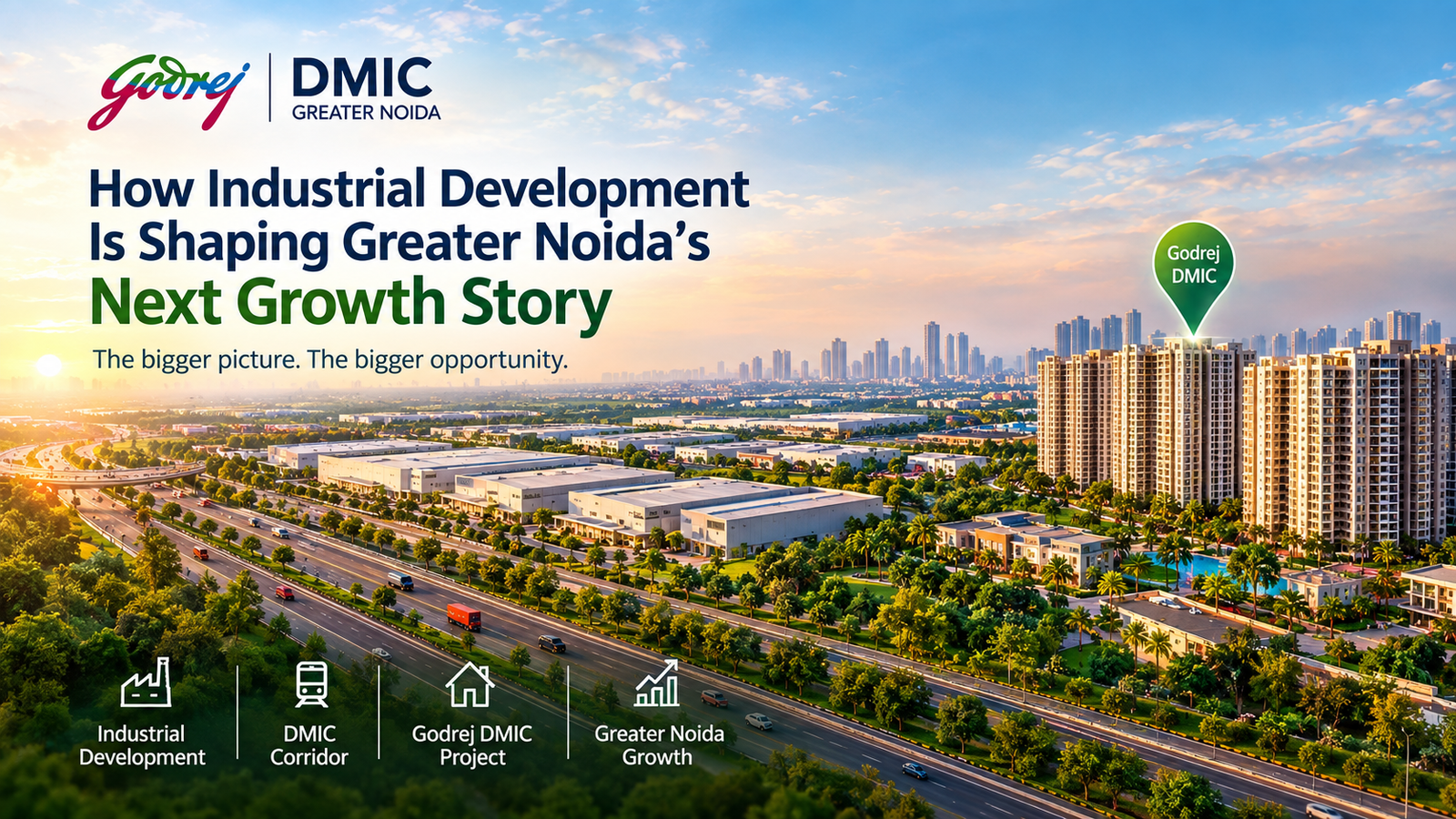
Godrej DMIC Project: How Industrial Development Is Shaping Greater Noida's Next Growth Story
Behind the new roads, logistics facilities, industrial developments and residential projects is a much larger story — the transformation of Greater Noida into an integrated economic and industrial destination.
At the centre of this transformation is the Delhi-Mumbai Industrial Corridor (DMIC) and, more specifically, the Integrated Industrial Township at Greater Noida.
This is where the story of the Godrej DMIC Project becomes interesting.
Rather than looking at the project simply as another residential development, it is worth understanding the larger industrial ecosystem around it. When manufacturing, logistics, employment, transportation and residential development begin growing together, the demand for quality housing and supporting infrastructure naturally follows.
The proposed Godrej development inside the DMIC Integrated Township is therefore closely connected with the broader economic development taking place across this part of Greater Noida.
What Is the Delhi-Mumbai Industrial Corridor?
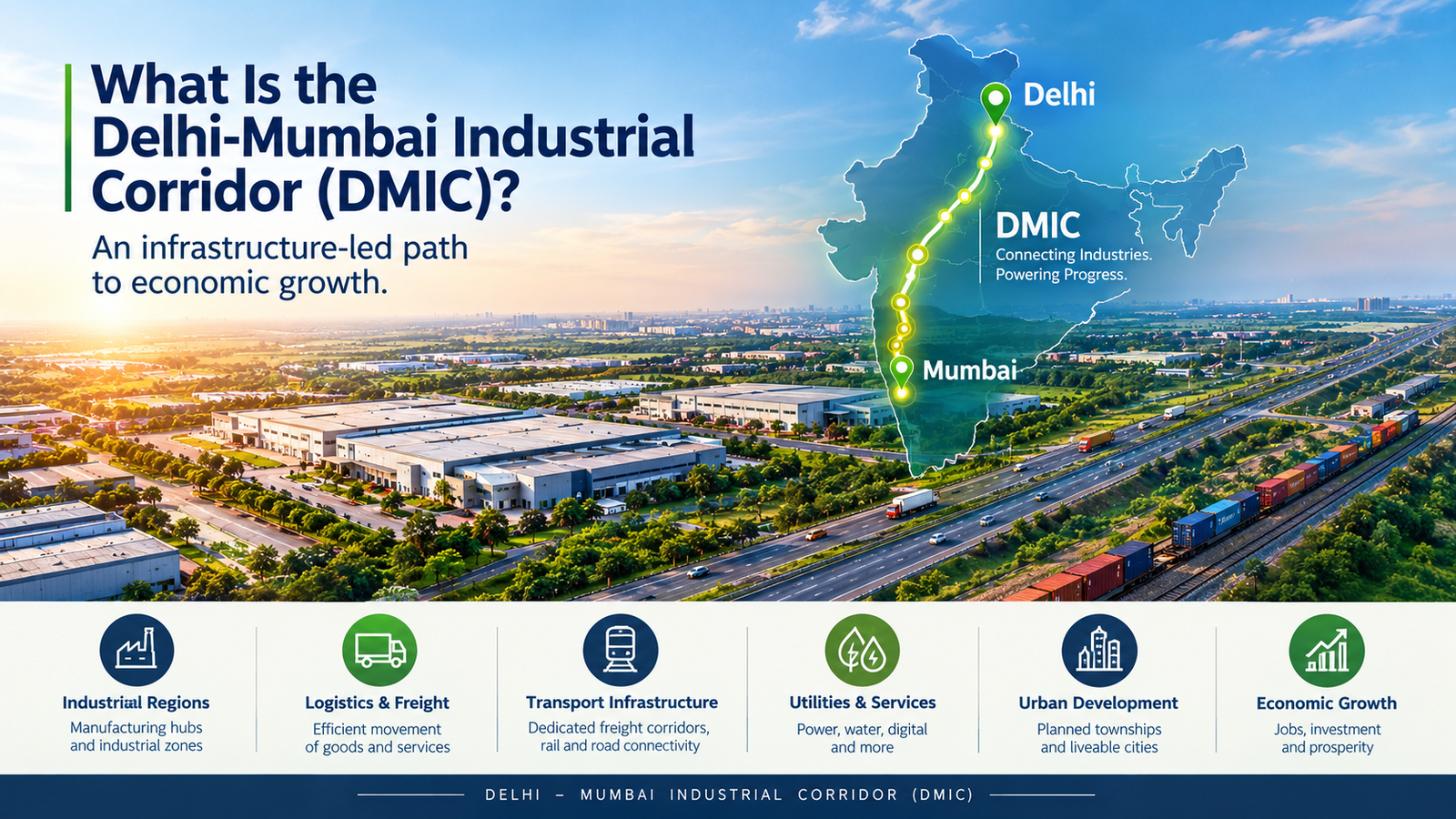
The Delhi-Mumbai Industrial Corridor, commonly known as DMIC, is one of India's major infrastructure-led economic development initiatives.
The idea is straightforward: create an integrated network of industrial regions supported by high-quality transport infrastructure, logistics, manufacturing facilities, utilities and urban development.
For Uttar Pradesh, the Dadri-Noida-Ghaziabad Investment Region (DNGIR) is an important part of this larger framework.
The Uttar Pradesh government's investment portal identifies the DNGIR as one of the key investment regions of the first phase of DMIC. Its strategic importance comes partly from its location around Dadri and its links with the Eastern and Western Dedicated Freight Corridors.
That connectivity is important because industrial development does not happen in isolation.
- Factories need raw materials.
- Manufacturers need logistics.
- Businesses need employees.
- Employees need housing.
And all of these require roads, railways, utilities, schools, healthcare and commercial infrastructure.
This is why an industrial corridor can gradually influence the entire real estate ecosystem around it.
Greater Noida's Industrial Development Is Becoming More Integrated
Greater Noida has been planned differently from many older parts of NCR. Instead of development happening entirely organically, large portions of the city have been planned around sectors, expressways, industrial zones and integrated townships. The Integrated Industrial Township at Greater Noida is one of the major projects under the DMIC framework.
According to the official DMIC Integrated Industrial Township Greater Noida website, the township covers approximately 302.63 hectares and has been developed to facilitate large-scale commercial and industrial investment in the DMIC region. It is designed around the idea of a sustainable, smart and integrated community.
The location also benefits from its relationship with major transportation infrastructure, including the Eastern Peripheral Expressway and the Delhi-Howrah railway line.
This is where industrial development starts becoming relevant to residential real estate.
A successful industrial and logistics ecosystem creates more than factories and warehouses. It creates an employment ecosystem.
And employment ecosystems eventually create housing demand.
Why Industrial Development Matters for Residential Real Estate
It is easy to look at a residential project only through the lens of apartments, amenities and floor plans.
But location often has a much bigger influence on the long-term character of a property.
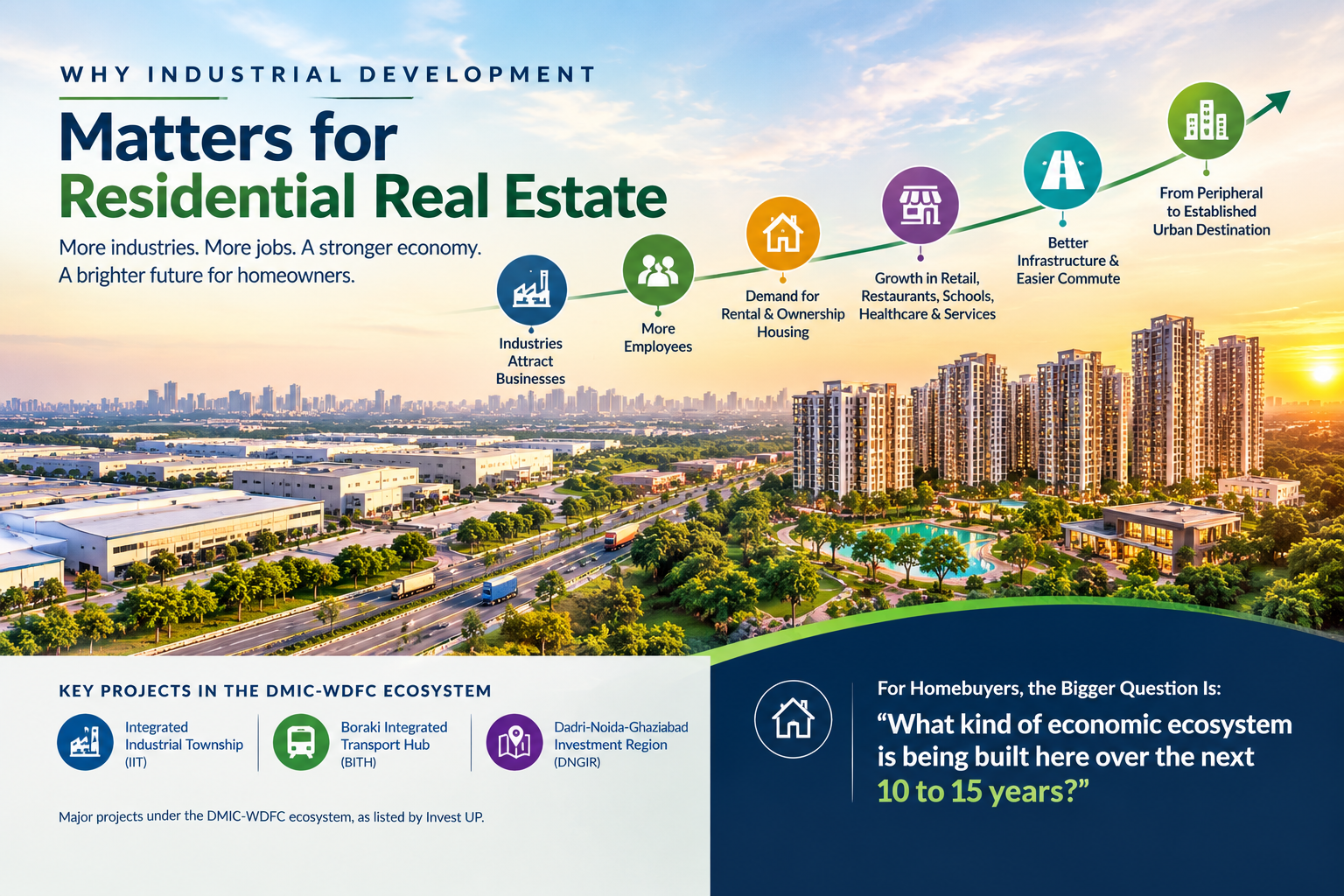
Consider what happens when an area attracts businesses and industries.
- More companies mean more employees.
- More employees mean demand for rental housing and ownership housing.
- More economic activity supports retail, restaurants, schools, healthcare and other services.
- Improved infrastructure makes commuting easier.
Over time, the area can evolve from a peripheral location into an established urban destination.
This is one reason industrial corridors have a wider impact than their industrial boundaries suggest.
The Uttar Pradesh government has identified the DMIC ecosystem as an important vehicle for industrial investment, employment generation and infrastructure-led growth. Invest UP also lists the Integrated Industrial Township, Boraki Integrated Transport Hub and the Dadri-Noida-Ghaziabad Investment Region among the major projects associated with the DMIC-WDFC ecosystem.
For homebuyers, this creates a different way of evaluating Greater Noida.
Instead of asking only, "What is being built here today?", the more useful question may be:
"What kind of economic ecosystem is being built here over the next 10 to 15 years?"
Where Does Godrej DMIC Fit Into This Development?
This is where the proposed Godrej DMIC Project in Greater Noida enters the picture.
On June 1, 2026, Godrej Properties won a bid for a 23.2-acre residential land parcel within the DMIC Integrated Township in Greater Noida through an e-auction conducted by DMIC Integrated Industrial Township Greater Noida Limited.
The company plans to develop a premium group housing project on the site, with an estimated revenue potential of more than ₹7,000 crore.
The development is being associated with the name Godrej Global Business City, and its location inside the DMIC Integrated Industrial Township gives it a very different positioning from a standalone residential project.
The important point is not simply the size of the land parcel.
It is where the land parcel is located.
The project sits within a larger planned ecosystem that combines industrial development, infrastructure and urbanisation.
That can potentially make the residential development part of a much broader growth story.
Godrej DMIC and the Rise of an Integrated Township
Modern cities are increasingly moving towards integrated development.
People don't want to spend hours travelling between their homes, workplaces and essential services.
Businesses, meanwhile, prefer locations where infrastructure, transportation and workforce availability are already developing.
This is the logic behind integrated townships.
The DMIC Integrated Industrial Township at Greater Noida has been planned with smart infrastructure and a mix of industrial and urban functions. The government originally projected that the township could attract significant private-sector investment and generate direct and indirect employment through industrial development.
The proposed Godrej development adds another layer to this ecosystem: large-scale residential housing.
That creates an interesting relationship:
Industrial growth → employment → population growth → housing demand → supporting retail and social infrastructure → stronger urban ecosystem
This does not mean every property automatically appreciates or that returns are guaranteed.
However, it explains why infrastructure-led locations attract attention from both end users and long-term investors.
Connectivity Is One of the Biggest Advantages
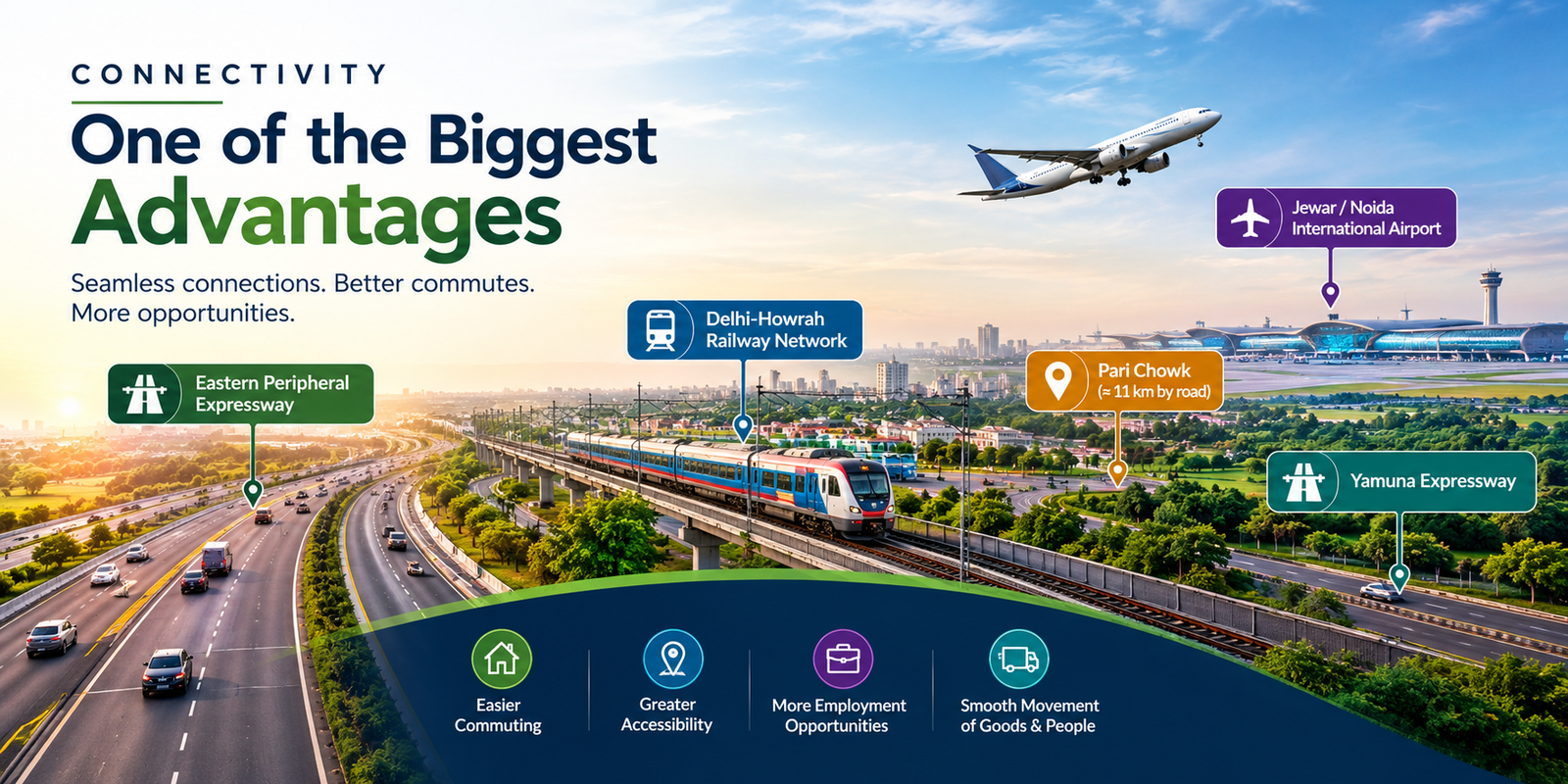
Industrial development depends heavily on connectivity.
The same is true for residential real estate.
The DMIC Integrated Township is positioned close to major transportation infrastructure, including the Eastern Peripheral Expressway and the Delhi-Howrah railway network. The township is also around 11 km by road from Pari Chowk, according to the official township website.
The broader Greater Noida ecosystem also benefits from the Yamuna Expressway and connectivity towards the emerging Jewar/Noida International Airport region.
For a residential project, these connections matter because they influence commuting, accessibility and the ability to connect with other employment centres across NCR.
For an industrial project, they matter because they support movement of goods and people.
That overlap is precisely what makes the DMIC location interesting.
Godrej DMIC: More Than Just a Residential Project?
Calling Godrej DMIC simply a residential project may actually miss the larger picture.
The project is residential in terms of its planned development, but its location connects it with a much larger economic ecosystem.
The proposed 23.2-acre development is planned as a group housing project, while information associated with the development also refers to a business-centre component.
This combination reflects an important trend in NCR real estate: the gradual movement towards mixed-use and integrated urban environments.
A home becomes more valuable as a lifestyle proposition when employment centres, transportation, commercial activity and social infrastructure are available within reasonable reach.
This is particularly relevant in emerging areas, where today's open land can become tomorrow's urban neighbourhood.
Why Greater Noida Is Attracting Attention From Developers
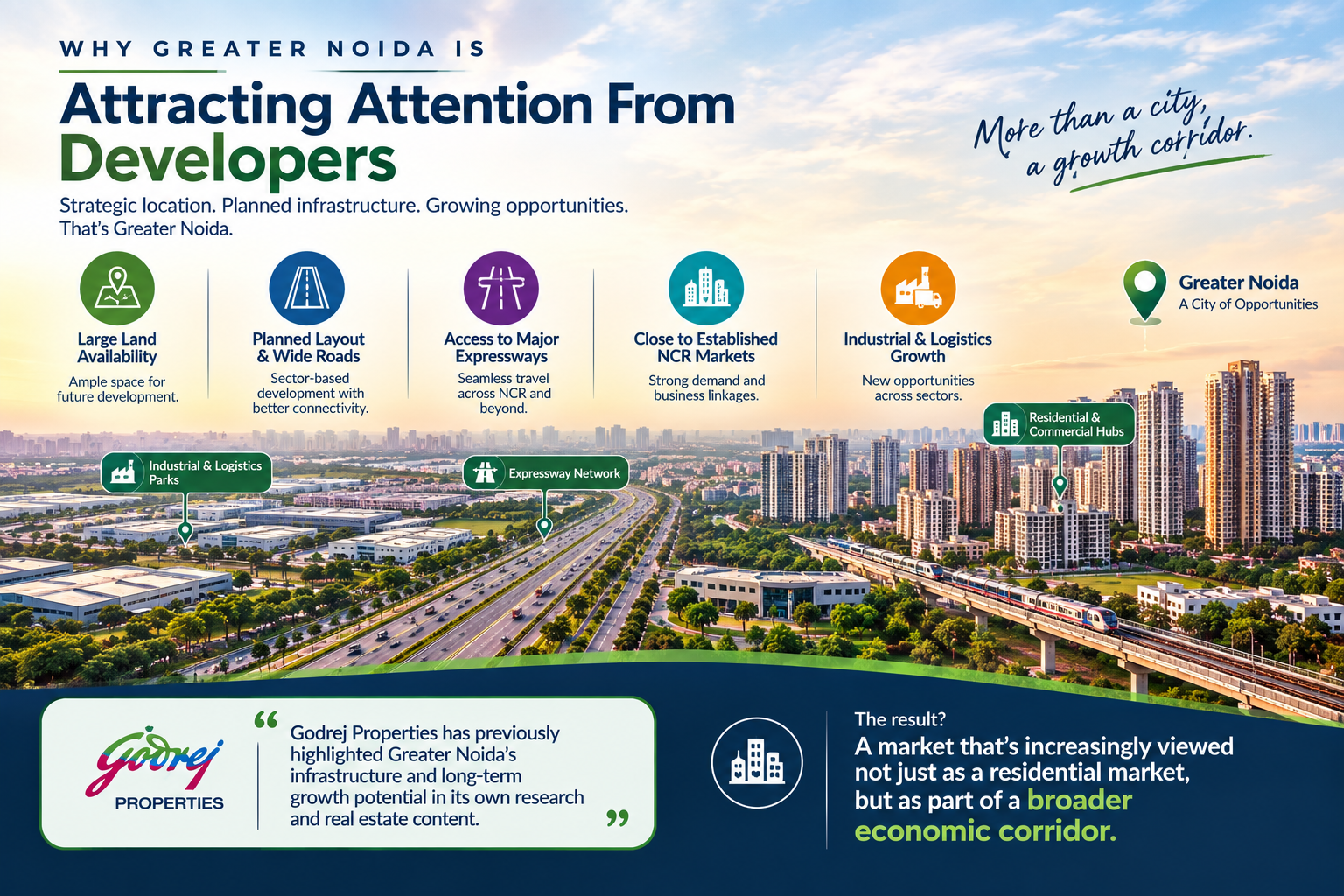
Greater Noida has several advantages that make it suitable for large-scale development.
- There is comparatively large land availability.
- The city has been planned around wide roads and sector-based development.
- It has access to major expressways.
- It sits close to established NCR markets.
And now, industrial and logistics development is adding another layer to the growth story.
Even Godrej Properties has previously highlighted Greater Noida's infrastructure and long-term growth potential in its own research and real estate content.
The result is a market that is increasingly being viewed not simply as a residential market, but as part of a broader economic corridor.
What Could Industrial Growth Mean for Godrej DMIC?
For a prospective homebuyer, the industrial development around Godrej DMIC can matter in several ways.
1. Employment Generation
More industrial and commercial activity can create employment opportunities in manufacturing, logistics, technology, services and supporting industries.
That can increase the need for housing close to employment centres.
2. Better Infrastructure
Large economic projects typically require supporting infrastructure.
Roads, utilities, transportation and logistics networks are not only useful for businesses. Residents benefit from them too.
3. Supporting Commercial Development
As population and employment increase, demand for everyday services tends to follow.
Retail, restaurants, offices, healthcare and education can gradually become more viable as an area's population grows.
4. Improved Regional Connectivity
The DMIC ecosystem is closely connected with freight and transportation infrastructure.
For residents, this can translate into better access to major roads and employment destinations.
5. Long-Term Urbanisation
The biggest potential impact may simply be urbanisation.
A location that starts as an industrial or infrastructure-led development can gradually become a complete urban neighbourhood.
That transition is often what real estate investors and end users are watching.
Godrej DMIC vs. a Standalone Residential Location
There is an important distinction between buying a home in an established residential neighbourhood and buying in an emerging integrated development.
An established neighbourhood already has most of its ecosystem.
An emerging location offers something different: the possibility of participating in the growth of that ecosystem.
Godrej DMIC belongs to the second category.
The project is being developed within an existing government-backed industrial township rather than being surrounded by an entirely standalone residential landscape.
That distinction is important when evaluating the project.
Of course, buyers should still examine the project's RERA registration, approvals, exact specifications, payment plans, possession timeline and final pricing before making a purchase decision.
Godrej DMIC and the Future of Greater Noida
The Greater Noida story is gradually moving beyond residential construction.
The combination of DMIC, dedicated freight infrastructure, industrial development, logistics, expressways and planned urbanisation is creating a larger economic narrative.
The Integrated Industrial Township is an important piece of that puzzle.
Godrej Properties' entry into the township with a 23.2-acre residential development adds another significant component: large-scale housing for the people who will eventually live, work and invest in this growing ecosystem.
This is why the Godrej DMIC Project deserves to be evaluated not only as a property launch, but also in the context of Greater Noida's long-term industrial and infrastructure development.
The real story is bigger than one project.
It is about how an industrial corridor can gradually shape a city.
Should You Explore Godrej DMIC Greater Noida?
If you are considering property in Greater Noida, the Godrej DMIC Project is worth studying from both a project and location perspective.
Its 23.2-acre land parcel, planned residential development and position inside the DMIC Integrated Industrial Township make it particularly relevant for buyers who are looking at emerging infrastructure-led locations.
For a detailed look at the project's location, configurations, amenities, price information and other available details, visit our Godrej DMIC Greater Noida.
You can also explore our related guides on Godrej projects in Greater Noida, Greater Noida real estate and properties near the DMIC corridor to understand the broader market.
Final Thoughts
Industrial development rarely transforms a location overnight.
It happens gradually.
First come infrastructure investments. Then businesses and logistics. Employment follows. Residential demand increases. Commercial activity grows. And eventually, an emerging corridor starts functioning like a city.
Greater Noida is moving through this kind of transformation.
The DMIC Integrated Industrial Township is an important part of that journey, and the proposed Godrej development brings residential real estate directly into the middle of this larger growth story.
For buyers, the key is to look beyond the brochure.
- Understand the infrastructure.
- Understand the industrial ecosystem.
- Understand connectivity.
- And then evaluate the residential project itself.
That is the better way to understand Godrej DMIC Greater Noida — not as an isolated address, but as a residential development positioned within one of Greater Noida's larger industrial and infrastructure-led growth corridors.
Frequently Asked Questions
What is the Godrej DMIC Project?
Godrej DMIC refers to the proposed Godrej Properties residential development planned on a 23.2-acre parcel within the DMIC Integrated Industrial Township in Greater Noida. Godrej Properties acquired the parcel through an e-auction in June 2026.
How big is the Godrej DMIC project?
The land parcel secured by Godrej Properties measures approximately 23.2 acres.
What is the connection between Godrej DMIC and the Delhi-Mumbai Industrial Corridor?
The project is located inside the Integrated Industrial Township at Greater Noida, which forms part of the wider Delhi-Mumbai Industrial Corridor and the Dadri-Noida-Ghaziabad Investment Region.
Why is industrial development important for residential property?
Industrial and commercial development can generate employment, improve infrastructure and increase demand for housing and supporting services. However, actual property appreciation is never guaranteed and should be assessed using project-specific and market-specific data.
Is Godrej DMIC suitable for investors?
The project's location within a planned industrial township may make it interesting for buyers considering long-term Greater Noida growth. However, investors should independently evaluate pricing, RERA status, project approvals, possession schedule, developer terms and market conditions before investing.
Is Godrej DMIC suitable for end users?
It may appeal to buyers looking for a home in an emerging infrastructure-led part of Greater Noida. The right choice will depend on commuting requirements, budget, configuration, amenities and the buyer's expected timeline.